With artificial intelligence and robotics developing at a rapid pace, simulation and the creation of digital copies of real environments play an increasingly important role. It is an area where Robotec.ai has broad experience, covering mines, agricultural sites, urban areas, warehouses and factories. The rise of AI and a wave of new tools have made building digital twins faster than ever. Speed, however, does not always go hand in hand with quality. At Robotec we always put quality first, which is why we think it is worth clarifying two terms that are often used interchangeably: the digital twin and the digital cousin.
Twin or cousin?
Digital twin – a faithful copy of an environment, built to a predefined accuracy. Mesh shapes, colours and object placement should be as close to reality as possible. The quality of a digital twin depends on the input data, which can range from highly accurate LiDAR scans to much less precise video footage. Whatever the source, the goal is always the same: reproduce the environment as accurately as the data allows.
Digital cousin – a copy of an environment in which the input data serves only as a general reference. The overall look usually resembles the original, but the 3D models can differ from the real objects. Each object should be of the right type, but it may come from a different brand, have a different colour, or only roughly match the original shape. Placement doesn't have to be exact either and may be loosely based on the input data.
Both have their place. A digital cousin can be enough to provide variety for training or a quick first look at a scenario, while a digital twin is needed wherever results must carry over reliably to a specific real-world site.
Four ways to build a 3D model
When comparing the two kinds of simulation, we will focus on the visual side, that is, on 3D modelling. In the standard pipeline, most of the work is done by 3D artists. They process the input data, interpret it, and then build the models and their textures by hand. Alongside it, there are now pipelines in which models are generated, partly or entirely. Generated models fall into three main groups:
- Models reconstructed from 3D scans (LiDAR, photogrammetry). Point clouds are turned into meshes with classic surface-reconstruction algorithms such as Poisson reconstruction. Newer methods such as NeRF (Neural Radiance Fields) and Gaussian Splatting first build a radiance-field representation of the scene, from which a mesh is then extracted. AI-based tools can support any of these steps.
- Generative image-to-3D models – often simply called image-to-3D or 3D generative AI. A trained AI model reconstructs a 3D object, together with its texture, from one or a few photos. Open-weight examples include TRELLIS / TRELLIS.2 (Microsoft, MIT licence), SAM 3D Objects (Meta), Hunyuan3D 2.x (Tencent), TripoSR (Stability AI and Tripo, MIT) and InstantMesh (Tencent ARC, Apache 2.0).
- Models created by LLMs. A large language model drives existing software, for example Blender, through the Model Context Protocol (MCP), and builds models based on the selected input data.
Twin or cousin: what each method delivers
Once we know how the creation processes differ, we can decide which method fits a digital twin and which a digital cousin.
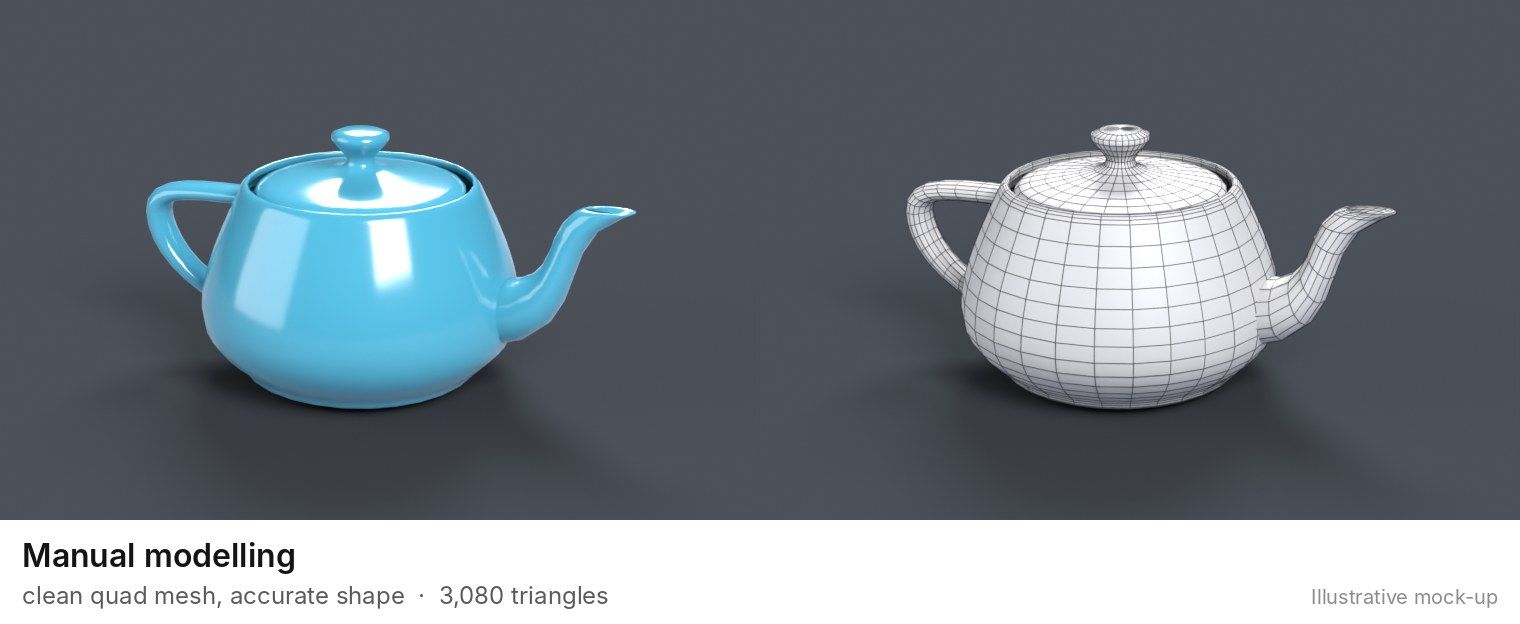
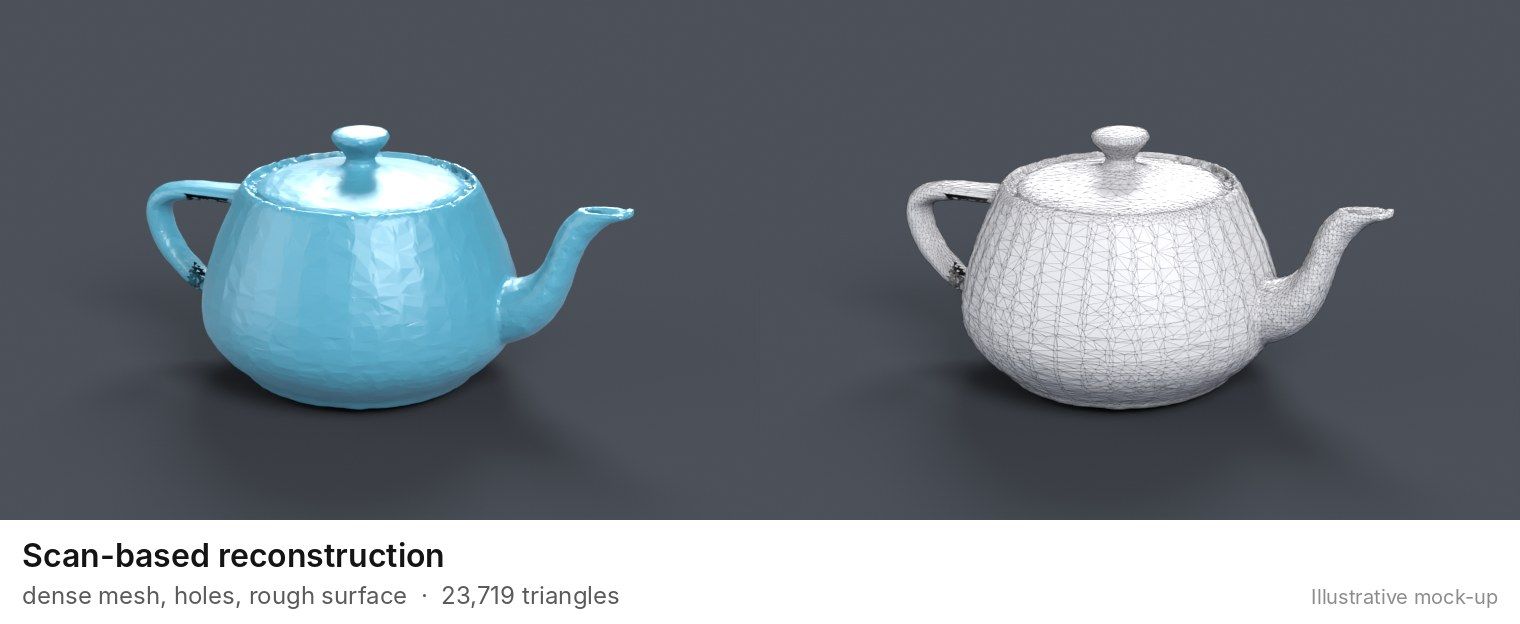
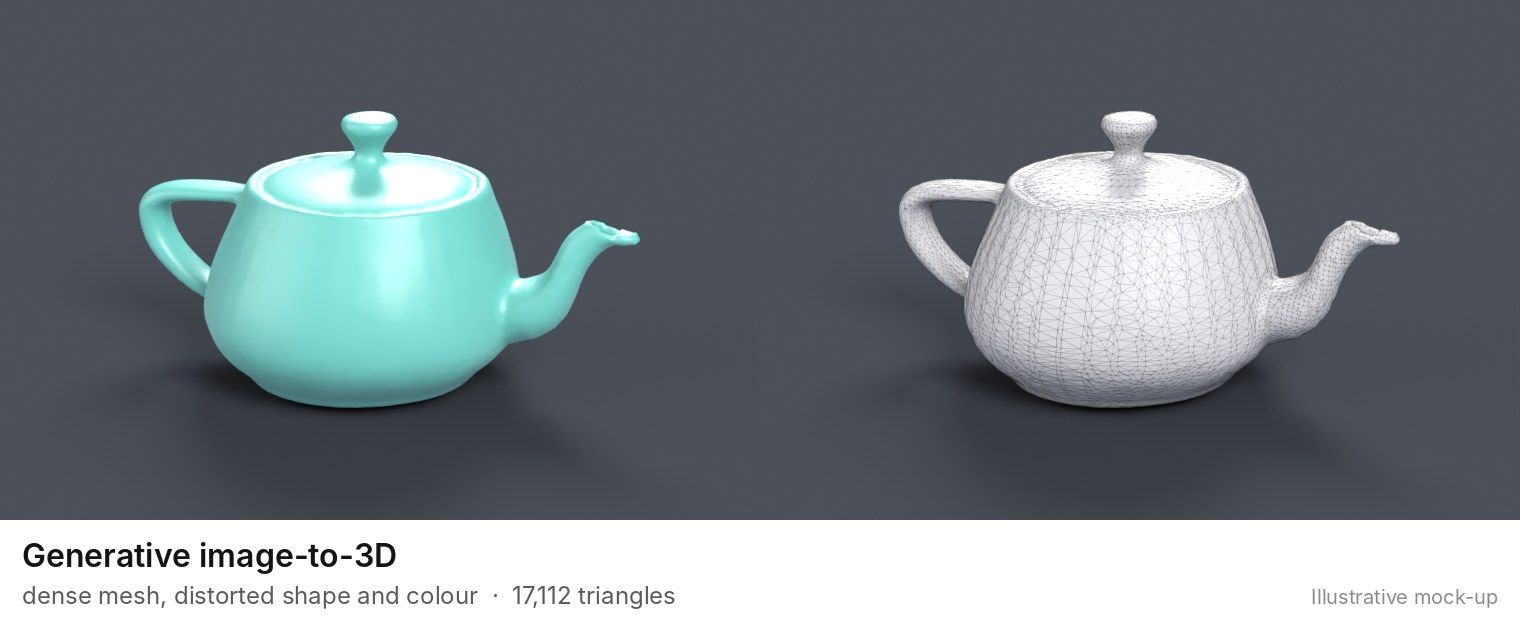
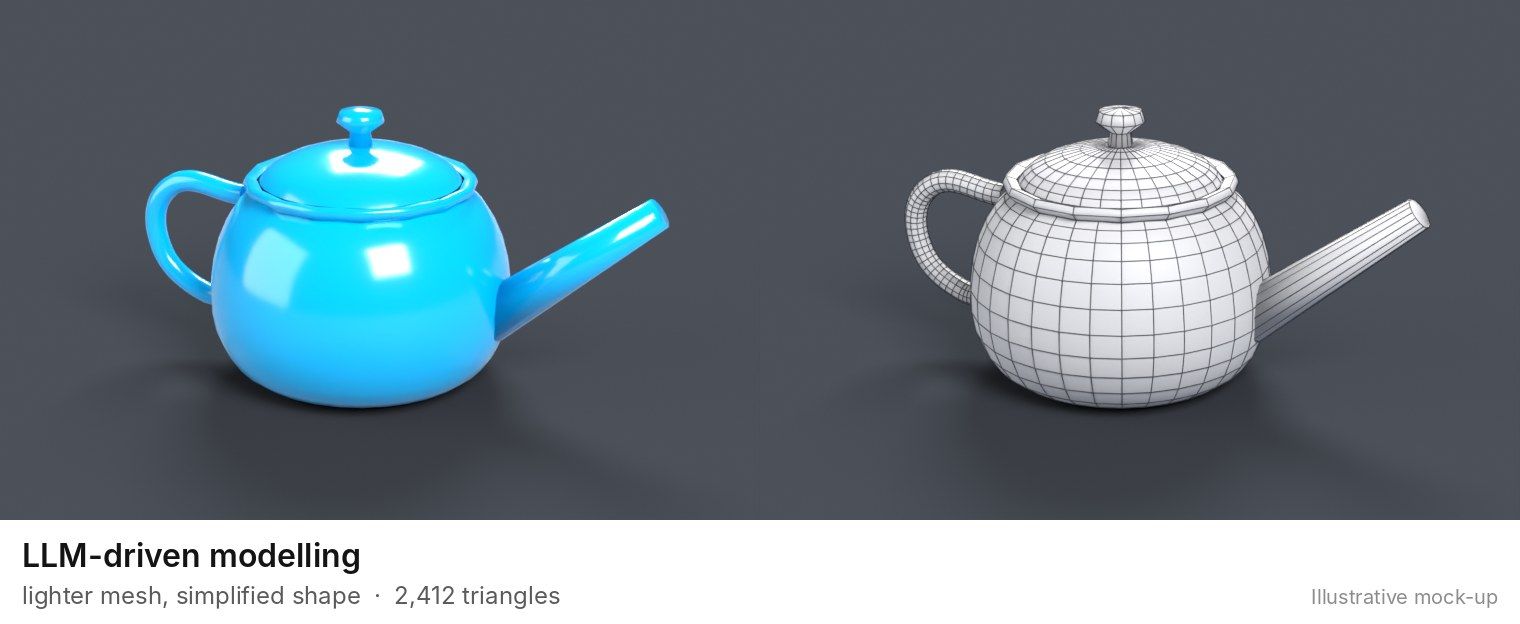
The images in this section are illustrative graphics only, not real outputs of these tools. To show the typical differences, we recreated the classic Utah teapot four times in Blender, imitating the result of each method. Each image shows the shaded model on the left and its mesh on the right.
Manual modelling: a digital twin
Work done by people usually results in a digital twin. Following the project guidelines, a 3D artist builds the most accurate model possible, using a range of tools to get the mesh shape, details, textures and physical properties right, including animations and moving parts. The quality of the model depends on how much time the artist puts into it. Both shape and colour are reproduced as faithfully as possible. On top of that, hand-made models are well optimised and easier to use in simulation.
Scan-based reconstruction: a digital twin, if the data is good
Models created from 3D scans can also be called digital twins, because they are based on real measurements. Their accuracy, however, depends heavily on the quality of the captured data. With good equipment and a careful scan, shape and colour can be reproduced very well. Capturing that data takes a lot of attention, and the result will still rarely match the clean, complete work of a 3D artist. Typical limitations:
- Thin, transparent, reflective or sharp-edged elements may not be reproduced accurately.
- Gaps appear wherever an object was hidden behind another one closer to the camera.
- The scan is one continuous surface rather than separate objects, so dynamic or movable objects have to be split out by hand.
- Things that should not be in the scene, such as people and vehicles, have to be removed.
- The resulting mesh is irregular and dense. It is heavy for a simulator, and using many copies of such a model can cause a significant drop in performance.
Generative image-to-3D: between twin and cousin
In terms of mesh, generative 3D models often resemble scan-based ones: the geometry is heavy and irregular. Many tools offer mesh simplification, but this can cost accuracy and detail and introduce errors. These models also carry a risk of hallucination. The AI has to invent everything the photos do not show, so the generated model often differs from the original in shape, details and colours.
LLM-driven modelling: a digital cousin
Models created with LLMs are digital cousins. They are heavily simplified and depart from the source data. An LLM can read many kinds of input (CAD, photos, video, LiDAR), but its interpretation can vary widely. The resulting meshes are light and simulation-friendly, though often too simplified. Objects end up in different positions or colours, the LLM frequently adds things that were not in the input, or leaves out important elements. Asking it to re-analyse and rebuild the model is possible, but often just introduces new errors. LLM-driven modelling does have one practical advantage. The LLM builds the scene object by object, so every model is a separate asset from the start. Unlike scan-based or generative reconstructions, no segmentation step is needed to split the scene into individual objects. LLMs are improving quickly at understanding spatial data (as of October 2026), but they still fall well short on accuracy. The speed of model creation, together with the hype, leads many people to present this as a new way of building digital twins. It is important to be aware that the result is not a faithful reproduction. LLMs certainly speed up the work and the simulation-building pipelines, but on their own they cannot generate a high-quality digital twin.
Real example: a digital cousin by an LLM
An LLM agent working in Blender rebuilt a real office using only its Gaussian splat as reference.
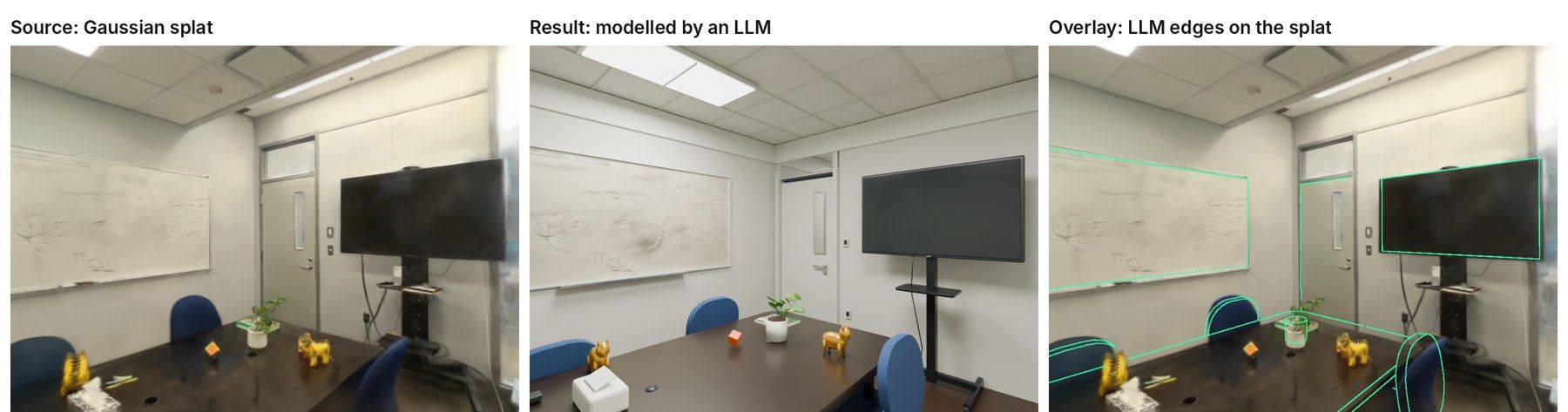
The layout and large objects line up well with the splat, but the details drift: the figurines and cube look different, and cables, sockets and smaller items are missing. A convincing digital cousin, not a digital twin.
Source splat: Brush_RawDualFisheye_30k by ichsan2895 on SuperSplat, based on the room3 dataset from the Full Circle paper, licensed CC BY 4.0.
One object, three methods
Here is another example of these differences in practice, this time on a single object: a detailed robot bust in a museum display case.
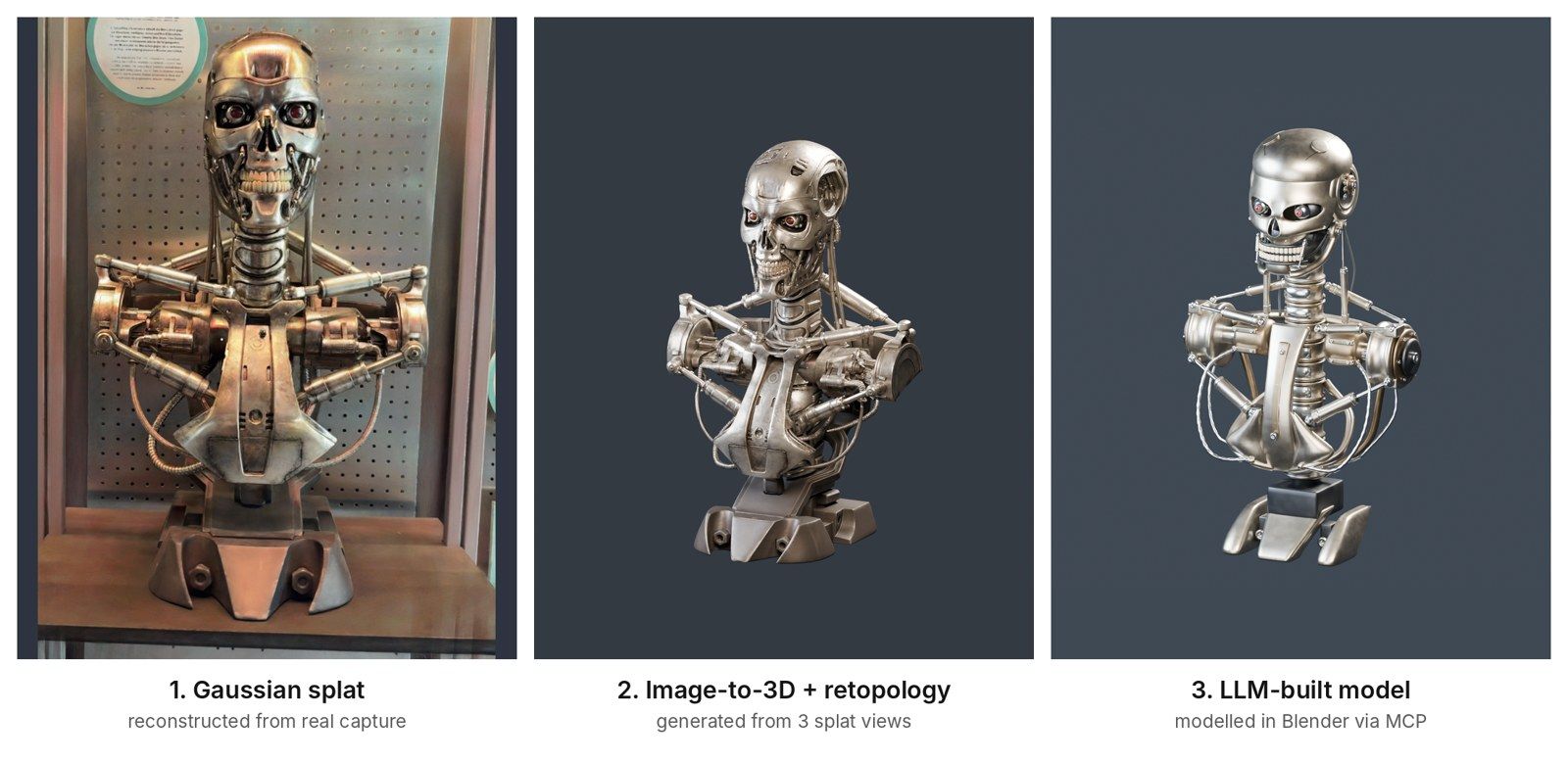
Source splat: Nixdorf computer museum – The Terminator by gorank on SuperSplat, captured at the Heinz Nixdorf MuseumsForum in Paderborn, licensed CC BY 4.0.
- Gaussian splat reconstructed from a real capture. It is the closest to reality, reflections and display case included, but it is not yet a usable 3D model.
- Image-to-3D + retopology. Three views rendered from the splat were fed to a generative model (Meshy), and the result was then retopologised in Blender. It stays close to the original in shape and detail, though not every part matches.
- LLM-built model. An LLM agent modelled the object from scratch in Blender, using the splat as reference. The object type is clearly right, but the shapes, proportions and details have drifted from the original: a typical digital cousin.
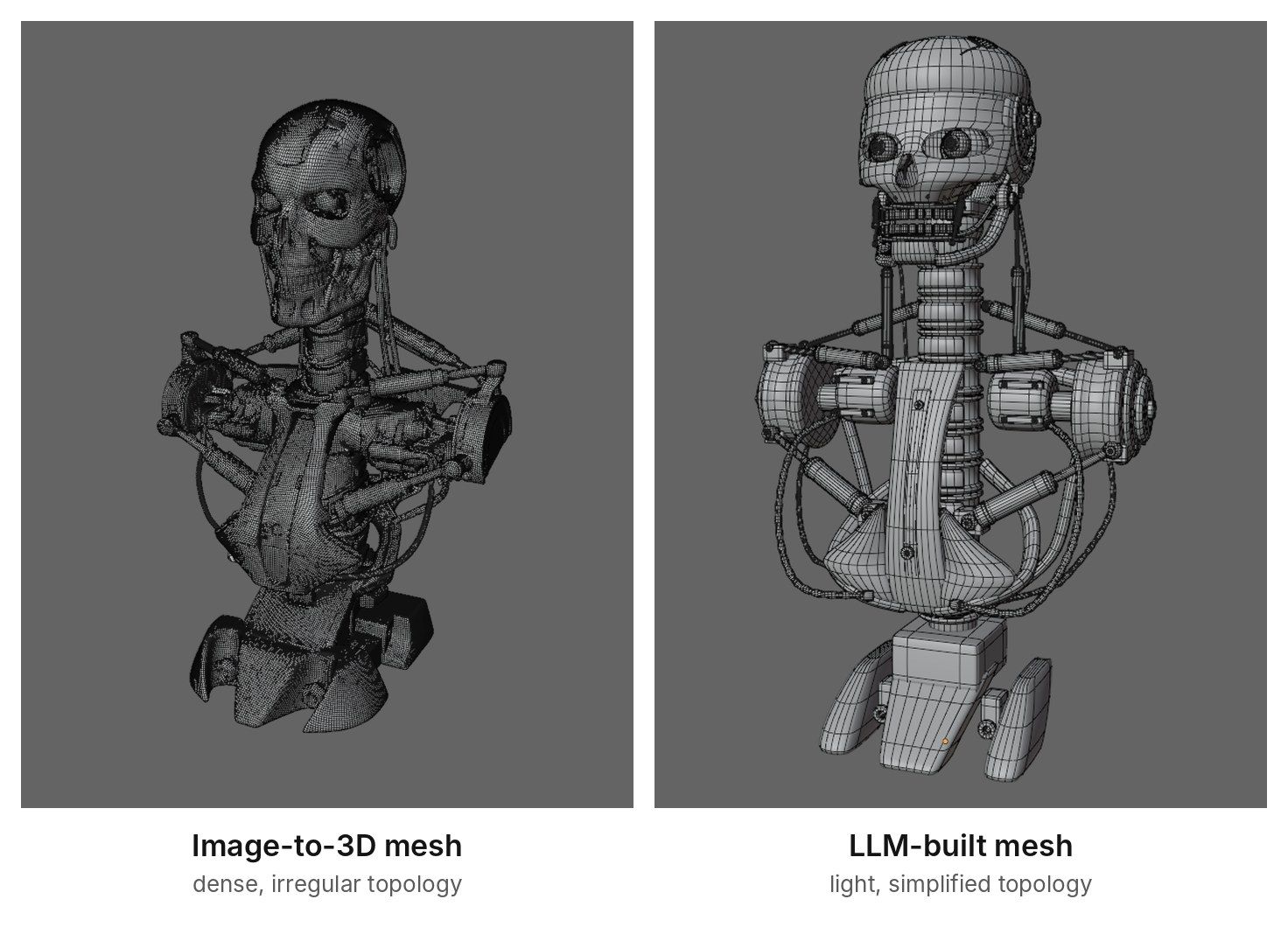
The meshes tell the rest of the story. The raw image-to-3D output is dense and irregular, which makes it heavy for a simulator. The LLM-built mesh is clean and light, but simplified.
Summary
| Method | Result | Accuracy | Mesh for simulation |
|---|---|---|---|
| Manual modelling | Digital twin | High, limited by artist time | Clean and optimised |
| Scan-based reconstruction | Digital twin | High, if the capture is good | Dense and irregular |
| Generative image-to-3D | Between twin and cousin | Medium, risk of hallucination | Dense and irregular |
| LLM-driven modelling | Digital cousin | Low to medium | Light, often oversimplified |
AI tools are changing how fast we can build simulation environments, and we use them every day. But a fast result is not automatically a digital twin. When a simulation has to match a real site, the model has to be anchored in real data and checked against it, with AI speeding up the work rather than replacing the measurements.
Interested in our latest projects? Follow us on LinkedIn to always stay updated!
You can also visit our GitHub page to learn more about our open-source projects.
Authors:
- Piotr Rząd, Robotec.ai