Robots don't have an internet's worth of data to learn from. Coding agents may not need one, as long as they have a good place to experiment.
Over the past few months, a new recipe for teaching robots has started to show results. Instead of collecting thousands of demonstrations and training a policy end to end, a frontier AI model writes the robot's control code, tests it in simulation, reads the results, and rewrites it. Real hardware is used sparingly, to check the code and correct the simulation. In one recent study, this approach got a dual-arm robot to succeed in 26 of 30 real-world trials across three tasks, using about ten minutes of physical robot time per task; no competing method managed more than 3 of 30.
In this post we explain where the idea comes from, why it works now, and why it puts simulation at the centre of Physical AI development. We close with the practical problems teams will hit when they try it, and what we think helps.
Physical AI has a data problem
Physical AI is the umbrella term for AI systems that perceive and act in the physical world: robot arms, mobile robots, humanoids, autonomous vehicles. It sits where two fields meet. From AI it takes large learned models, such as vision-language-action (VLA) models that map camera images and an instruction straight to motor commands. From robotics it inherits everything that makes the real world hard: friction, contact, sensor noise, safety, and actions that cannot be undone.
The learned-model approach works best with huge amounts of data, and that is where robotics falls short. Language models train on text that would take a human roughly 100,000 years to read. Ken Goldberg of UC Berkeley calls this the robotics "data gap": there is no comparable store of robot experience. Teleoperation produces data at the speed of the operator (eight hours of work yields eight hours of data). Videos of people lack the forces and precise motions a robot needs. Pooled datasets are growing, but they cover particular robots, grippers and scenes.
The data gap matters most outside the lab. A warehouse or factory deployment needs a robot that is reliable on this site, with these totes, under this lighting. Collecting a new demonstration set every time the layout changes does not scale.
Meanwhile, the models learned to reason about space and write code
While robot datasets grew slowly, general-purpose models improved fast on two skills that matter here.
The first is spatial and physical reasoning. In October 2026, Google DeepMind showed Gemini 4 Argon a video of a person playing cornhole. The model built a physics simulation of the game in the open-source MuJoCo simulator, worked out whole-body control for an Apptronik Apollo 2 humanoid, and the real robot then landed seven shots in a row. DeepMind describes this "video-to-sim-to-real" pipeline as cutting weeks of manual modelling down to a few hours.
The second is agentic coding. Coding agents no longer just write a function on request. They can work on a codebase for hours: run the tests, read what failed, form a guess about why, and try a fix. For robotics, that debugging loop matters more than getting code right in one go.
Together these suggest a different route around the data gap. If a model can reason about a scene and write and debug programs, it does not need to learn every motion from examples. It can engineer a solution, the way a robotics team would, only faster and around the clock.
Two ideas that meet: Code-as-Policy and Autoresearch
Code-as-Policy: the policy is a program
In robotics, a policy is whatever decides the robot's next action. It is usually a neural network. Code as Policies (Liang et al., Google, 2022) proposed something else: let a language model write the policy as ordinary code. The program calls perception functions ("find the red block"), uses loops and conditions, does geometry with numerical libraries, and calls motion primitives ("move gripper to pose").
Code has useful properties a neural policy lacks. You can read it, diff it, unit-test it and reuse it. It mixes freely with classical robotics: inverse kinematics, grasp planners and state machines that engineers have refined for decades. The catch in 2022 was that the code had to be right on the first try: there was no loop to test it, see what failed and fix it.
Autoresearch: the agent runs the experiments
In March 2026, Andrej Karpathy published autoresearch, a small experiment that caught a lot of attention. A coding agent got a roughly 630-line training script, one file it was allowed to change, a plain-text instruction file, and a fixed time budget per run. It then ran on its own: change the code, train, measure, keep what helps. Over two days it ran about 700 experiments and found 20 improvements, which cut training time for a larger model by 11%.
The lesson was not the 11%. It was that a tight loop with a clear metric lets an agent do useful research without a human approving each step. The metric and the guardrails carry most of the weight.
Put them together
Combine the two and you get an agent that improves robot control code by running experiments. The hard part is the experiment itself: a real robot is slow, needs supervision, and can break things. A simulator is where the loop can run thousands of times.
SimEX (Amazon FAR, UT Austin and CMU, 2026) is a clear recent example. From one photo and a short description of the workspace, the agent builds a rough simulation. It then spends hours there, inventing tasks, finding where its control code fails and improving it. Only then does it move to the real robot. After each real attempt, it replays the same code in simulation and adjusts the simulator until the replay matches what actually happened. It tests candidate fixes in the corrected simulation, and only the most promising one goes to the next real trial.
With five real adaptation trials per task, the results on a dual-arm robot were striking:
| Method | Plate to tote | Towel folding | Barcode scanning |
|---|---|---|---|
| Code-as-Policy, no iteration | 0/10 | 0/10 | 0/10 |
| Zero-shot sim-to-real | 0/10 | 2/10 | 0/10 |
| Best other agentic baseline | 2/10 | 1/10 | 0/10 |
| SimEX | 10/10 | 8/10 | 8/10 |
Source: SimEX paper, real-robot results, 10 evaluation trials per task. Baselines are the SimEX authors' re-implementations.
SimEX is not alone. NVIDIA's ASPIRE grows a library of validated code skills through parallel search in simulation. In his ICRA 2026 plenary, Ken Goldberg argued that agentic coding could close the gap between engineered and learned robotics, by composing classical skills and learned policies into readable programs. The common thread is that the agent's output is code, and simulation is where that code gets tested.
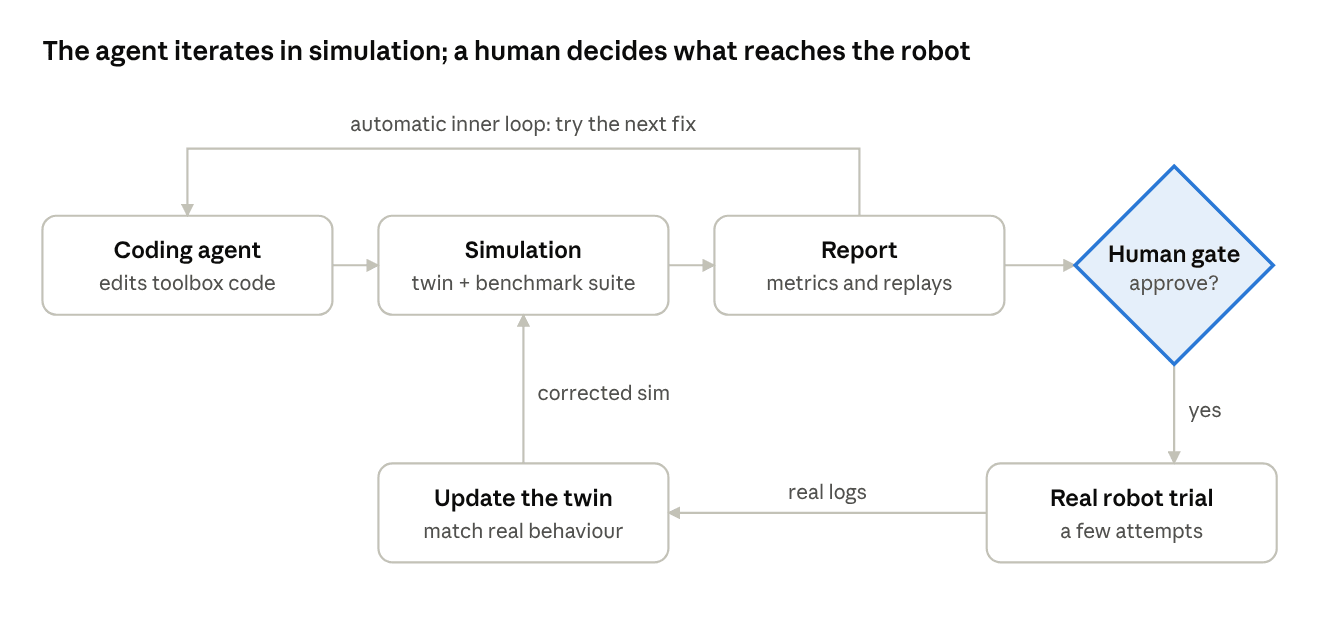
The agentic robotics loop: simulation inner loop, human gate, real-world correction
Put together, the loop looks like this. Most iterations never leave simulation, and the few real trials are used to make the simulation more accurate. The human gate is our addition: in SimEX the agent itself picks which fix to try next, and a person only resets the scene.
Simulation is the lab, and the lab has to be right
In autoresearch, the training run is the experiment, so the feedback is exact. In robotics, the simulator stands in for the world, so the feedback is only as good as the simulator. An agent optimises whatever it is measured on. If the simulated gripper never slips, or a simulated shelf is 10 cm lower than the real one, the agent will learn to rely on that mistake.
SimEX gets away with a rough simulation for two reasons. Its tasks happen in one small, fixed workspace. And its second stage keeps correcting the simulator against real trials. That correction step is itself a sign of where things are going: the closer the simulation starts to reality, the fewer expensive real-world trials are needed to fix it.
As tasks get more complex, the gap between "roughly similar" and "faithful" grows. Think of a mobile manipulator working across a real warehouse, a fleet sharing aisles, or a task that depends on exact rack heights and floor markings. There, a faithful digital twin of the actual operating environment becomes the foundation of the loop, not an optional extra. We covered the distinction between a precise digital twin and a looser "digital cousin" in an earlier post. Cousins are useful for variety; twins are needed when results must transfer to one specific site.
The second property that matters is speed. Karpathy's agent ran around 350 experiments a day. A robotics loop needs similar throughput: many scenarios, many random seeds, many candidate fixes evaluated in parallel. A simulator that takes an engineer a week to set up, or an hour to run a single episode, breaks the loop.
Four things to get right
The research is early (more on its limits below), but the shape of a working setup is becoming clear. Here is what we think teams should plan for.
1. Fast iteration, with every change measured
The agent is only as good as its feedback. Each candidate change needs to run against the same versioned set of scenarios, seeds and success criteria, so that "better" means something. Single-run success rates are noisy, so results need error bars and a side-by-side comparison with the previous version. Failures should come back with replays and logs the agent can actually inspect, as SimEX and ASPIRE both do.
This is the problem RoSi, our simulation platform, is built around. It turns evaluation into a fixed test suite that reruns automatically on every software update, across many simulations in parallel, so each change comes back with comparable numbers and replays of its failures.
2. Agents for speed, humans at the gates
Letting an agent iterate freely in simulation is cheap and safe. Letting it push code to a robot next to people is neither. The practical answer is to automate the inner loop and put a human sign-off at the gates: before a new toolbox version runs on hardware, and before it goes into production.
That only works if the human can make an informed decision quickly. The agent should hand over a report, not a pile of logs: what changed, why, which benchmarks improved or regressed, and replays of the remaining failures. The report should also state the known sim-to-real limits: which behaviours the simulator models well, and which it does not (deformable objects, say, or a specific sensor's reflections). A pass in simulation is evidence, not proof, and the reviewer needs to know how much weight it carries.
3. Environments that are quick to create and easy to improve
If every new site takes weeks of manual 3D modelling, the agent's speed doesn't matter. Building the environment has to be close to automatic, and the environment has to keep up when the real site changes.
The Gemini and SimEX examples both generate simulations from a video or an image, which is enough for one small workspace or a game. For a whole facility, the input needs to be richer. SLINGSHOT, our digital twin generator, builds a simulation-ready twin from LiDAR scans, photos and video within seven days of receiving the data. It delivers an OpenUSD scene (a standard 3D scene format) that loads into common robotics simulators such as NVIDIA Isaac Sim and O3DE, and can be refreshed as racking and layouts change.
4. Guardrails so the agent doesn't get lost
Left alone with a vague goal, a coding agent will wander, or optimise the score instead of the behaviour. Imagine a picking task scored simply as "the item ends up in the tote". If the simulator lets items pass slightly through the tote's wall, tossing an item can score as well as placing it carefully, and an agent tuned on that score will happily learn to toss.
Autoresearch worked partly because it was tightly scoped: one file to edit, a fixed time per run, written rules about what not to touch. Robotics needs the same discipline, in more detail:
- Clear, written success criteria for each task ("placed upright, no collision, under 8 seconds"), checked by code rather than by the agent's own judgement.
- Defined workflows: what the agent may change (its control code) and what it may not (the safety layer, the evaluation suite).
- Reusable instructions: short written guides, often called skill files, that tell the agent how each tool should be used and where its known limits are. SimEX keeps one alongside its code, and coding agents such as Claude support them directly.
- Budgets on time, compute and model calls. SimEX's simulation stage alone used about 5.4 hours of agent reasoning for each of its four parallel runs.
What it doesn't solve yet
The limits are worth stating plainly. The real-robot evidence is still small: SimEX tested three tasks on one robot model, with ten trials each. Results depend heavily on the frontier model behind the agent. On SimEX's hardest task, success rose from 67% to 82% just by switching to a stronger model, so both performance and cost are moving targets. Contact-rich and deformable tasks, like folding cloth, remain the hardest to simulate well, and that is where an agent tuned in simulation is most likely to be misled. And the systems are not fully autonomous: people still reset the scene between real trials. None of this undermines the approach. It does mean the engineering around the agent, from the environment to the benchmarks to the review process, decides whether it works in practice.
Where this leaves us
Agentic robotics will not replace learned policies; the two are increasingly combined, with code calling learned perception models and learned skills, as in Goldberg's "Graph-as-Policy" proposal. What changes is where engineering effort goes. Less of it goes into collecting demonstrations and hand-tuning controllers. More goes into the loop around the agent: a faithful environment, a trustworthy benchmark, clear criteria, and a human who signs off at the right moments.
That loop runs through simulation. The teams that can build an accurate twin of their site quickly, and measure every change against it at scale, will get the most out of the next generation of models.
Sources
- Google DeepMind, Teaching a humanoid robot to play cornhole with Gemini 4 Argon, October 2026
- Hu et al., SimEX: Simulation-Integrated Robotics AutoResearch, 2026
- Liang et al., Code as Policies: Language Model Programs for Embodied Control, 2022
- Fortune, Andrej Karpathy's autoresearch loop, March 2026
- Lu et al., ASPIRE: Agentic Skills Discovery for Robotics, 2026
- Ken Goldberg, A Tale of Two Cultures: Can Agentic Coding Close the Gap?, ICRA 2026 plenary
- The Robot Report, Why humanoid robots aren't advancing as fast as AI chatbots (Goldberg's 100,000-year data gap), September 2025
- Workshop on Agentic Robotics, CoRL 2026
Interested in our latest projects? Follow us on LinkedIn to always stay updated!
Want to try this loop on your own site? Get in touch with our team.
Authors:
- Adam Gotlib, Robotec.ai